Dr. Dimple Jindal Official Website
Does Money Buy Happiness? What 50 Years of Research Actually Says — And What Billionaires Know That You Don't
Wealth & Wellbeing · 9 min read · 2026-03-10
The data on wealth and happiness is more nuanced, surprising, and actionable than either side of the debate admits. Here is what the science actually says — and what truly fulfilled wealthy people do differently.
Article Summary
The data on wealth and happiness is more nuanced, surprising, and actionable than either side of the debate admits. Here is what the science actually says — and what truly fulfilled wealthy people do differently.
Full Article
There is a conversation humanity has been having with itself for centuries, and despite billions of dollars of psychological research, we have still not resolved it cleanly. Does money buy happiness?
The billionaire in his penthouse and the monk in his monastery seem to represent opposite answers. The research, when you actually read it carefully, tells a far more interesting story than either side admits.
The Study That Changed Everything — and the Follow-Up That Changed It Again
In 2010, Nobel Prize-winning psychologist Daniel Kahneman and economist Angus Deaton published findings that dominated the conversation for a decade: emotional wellbeing stops improving beyond an annual income of approximately $75,000. Above that threshold, more money stopped making people meaningfully happier in their day-to-day lives.
This finding was cited in thousands of articles, countless TED talks, and became the intellectual backbone of an entire genre of anti-hustle content.
Then the story got complicated.
In 2021, researcher Matthew Killingsworth published data from a much larger sample — over one million real-time experience reports from more than 33,000 employed adults — and found the opposite. Happiness continued to rise with income well beyond $75,000. There was no plateau.
When Kahneman and Killingsworth collaborated to reconcile their findings in 2023, the picture that emerged was far more textured than either original study captured. For most people, happiness does continue to increase with income beyond the original threshold. But for a specific subset of the population — those who describe themselves as deeply, chronically unhappy — additional income provides almost no relief. Their unhappiness is not primarily financial in origin.
This is the insight that most wealth-happiness debates miss entirely: money solves money problems with exceptional reliability. It does not reliably solve the other kinds.
What Money Actually Purchases That Matters
Financial security removes a specific and genuine category of human suffering. Poverty is not character-building; it is cognitively exhausting, physiologically stressful, and statistically associated with worse outcomes across virtually every metric of wellbeing. The relief of genuine financial security is real, significant, and should not be minimized.
But beyond the floor of security, the research on what money buys that actually matters points to something more specific than raw income: autonomy over time.
A landmark 2020 study published in the Proceedings of the National Academy of Sciences found that using money to buy time — paying others to handle tasks you dislike, choosing work that allows schedule flexibility, retiring from a job you hate — produces significantly more wellbeing than equivalent spending on material goods. The wealthiest people who report high happiness are almost universally those who have used their resources to protect and expand their control over how they spend their hours.
Zuko teaches Cosmo this principle early in the 30-day program in The Billionaire's Canvas. The goal is not the accumulation of zeros; it is the construction of what Zuko calls the "Currency of the Soul" — a life in which your time, attention, and energy are directed by your deepest values rather than by the demands of debt, obligation, and scarcity.
Beyond time, the research consistently identifies experiential spending as a significantly better investment in wellbeing than material accumulation. Spending money on experiences — travel, education, meals shared with people you love, creative pursuits — produces more lasting happiness than equivalent spending on objects. Objects adapt to. Experiences become part of who you are.
What Money Genuinely Cannot Buy — and Why This Matters for How You Build
The Harvard Study of Adult Development — the longest-running study of human flourishing ever conducted, tracking participants from the 1930s through to today — draws one conclusion above all others from 85+ years of data: the quality of close relationships is the single strongest predictor of long-term health, happiness, and cognitive vitality in aging.
Not income. Not career achievement. Not IQ. Relationships.
Money cannot manufacture genuine intimacy. It can fund the circumstances that allow intimacy to develop, but it cannot substitute for the actual investment of time, attention, vulnerability, and care that close relationships require. In The Billionaire's Canvas, this is the lesson of the Sangha — the imperfect, sometimes antagonistic team of five that Cosmo assembles with Zuko's guidance. Enya the architect, Kelly the textile weaver, Murphy the lawyer, Patrick the coder — they are not resources. They are the living fabric of Cosmo's success.
"You cannot walk alone," Zuko tells Cosmo, describing the Sangha Principle. "The myth of the sole founder is one of the most dangerous lies in business. It leads to the Snakes of Zahhak: the twin demons of Anxiety and Control that eat the leader alive."
Money also cannot purchase a sense of genuine purpose. Viktor Frankl, who developed his theory of meaning in the context of surviving Nazi concentration camps, observed that human beings can endure almost any how if they have a sufficient why. Purpose is not found through consumption. It is found through contribution — through work that matters, through relationships that deepen, through the experience of being genuinely needed and genuinely seen.
This is why the wealthiest people who report the lowest wellbeing are frequently those who built their financial success on a foundation of pure accumulation, without attending to the parallel construction of meaning, relationships, and self-knowledge. The Billionaire's Canvas opens with precisely this character: Luan, Cosmo's father, who chased volume and lost value, who focused on the transaction and forgot the human.
A More Useful Framework for Thinking About Wealth and Wellbeing
The binary debate — does money buy happiness? yes or no? — is the wrong frame. The better question, and the one Dr. Dimple Jindal's work points toward, is: what do you use wealth to build, and does what you're building create the conditions for genuine flourishing?
Financial security is a foundation, not a destination. Build it seriously and protect it intelligently. But treat it as a platform — from which to invest in the things that the data consistently shows actually drive long-term wellbeing: time sovereignty, deep relationships, meaningful experiences, ongoing growth, and the sense that your work and your life are aligned with something larger than your own comfort.
The billionaires who are genuinely flourishing are not the ones with the most zeros. They are the ones who understood, at some point in their building, that wealth is a tool. And like any tool, its value depends entirely on what you choose to build with it.
The Saffron Philosophy holds this principle at its core: we are not building for the balance sheet. We are building for the life the balance sheet makes possible. And that life requires far more than money to construct.
Author
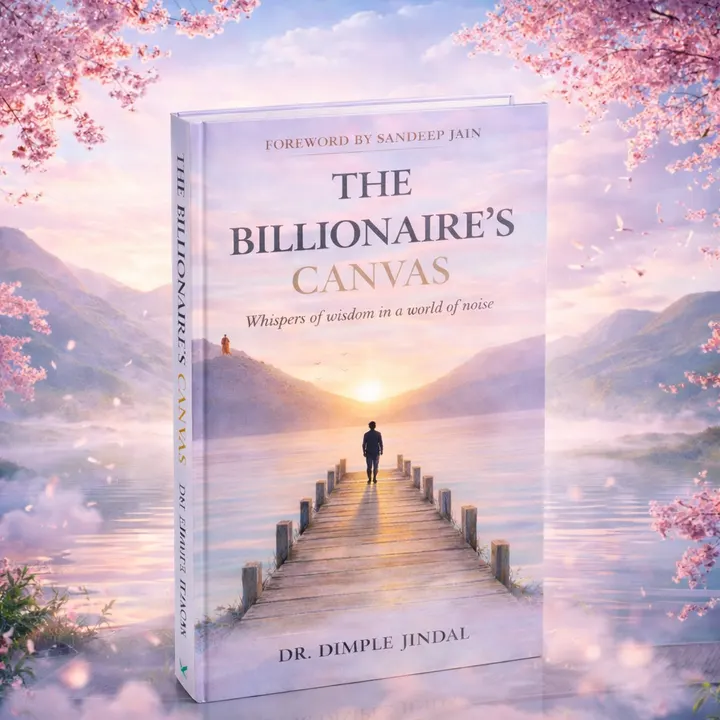
Dr. Dimple Jindal is the author of The Billionaire's Canvas: Whispers of Wisdom in a World of Noise, a business fiction novel about the Saffron Philosophy, ethical wealth, and meaningful success.
Related Reading
Continue with The Saffron Philosophy: Why the Most Valuable Businesses in the World Cannot Be Rushed, Copied, or Mass-Produced or The Billionaire's Soul: The Hidden Spiritual and Psychological Cost of Extraordinary Success Nobody Talks About. Then visit the Green Ledger, Digital Dharma, and Success, Wealth and Happiness guide to connect this essay with the wider Saffron Philosophy.
Continue Reading
- The Saffron Philosophy: Why the Most Valuable Businesses in the World Cannot Be Rushed, Copied, or Mass-Produced
- The Billionaire's Soul: The Hidden Spiritual and Psychological Cost of Extraordinary Success Nobody Talks About
- The Saffron Philosophy pillar essay
- The Green Ledger framework
- Digital Dharma technology ethics