Dr. Dimple Jindal Official Website
The Art of Focus: Why Your Attention Is Your Scarcest Resource — and How to Protect It in the Age of Digital Noise
Productivity & Focus · 10 min read · 2026-01-20
You have 24 hours today. So did Leonardo da Vinci and Einstein. The variable is not time — it is where your attention goes within that time. And attention has never been more aggressively competed for, or more poorly defended.
Article Summary
You have 24 hours today. So did Leonardo da Vinci and Einstein. The variable is not time — it is where your attention goes within that time. And attention has never been more aggressively competed for, or more poorly defended.
Full Article
You have twenty-four hours today. So did Leonardo da Vinci, Albert Einstein, and Maya Angelou. The variable is not time. It is where your attention goes within that time.
In the modern economy, attention has become the foundational resource upon which all other resources depend. The quality of your financial decisions, your creative output, your relationships, your physical health management — all of these are downstream of the quality and direction of your attention. And attention has never been more systematically fragmented, more aggressively competed for, or more poorly protected than it is in the current digital environment.
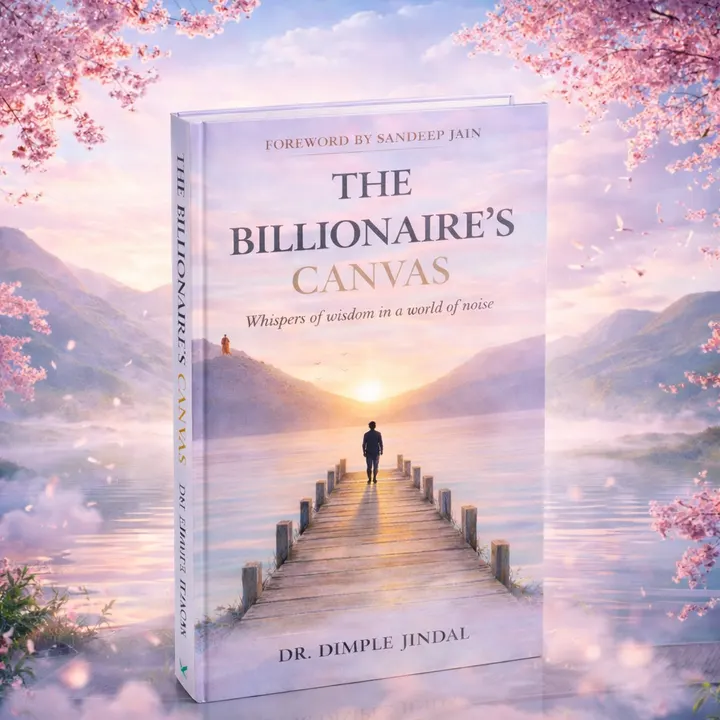
This is the core insight of what Zuko calls the "World of Noise" in The Billionaire's Canvas — the noisy, extractive economy that competes not primarily for your money, but for your attention. And the Saffron Philosophy's response to this world is not a productivity hack. It is a radical reorientation toward what Zuko calls the "Architecture of Silence": the deliberate design of your environment, time, and cognitive state to protect the conditions in which genuine thinking and genuine work become possible.
The Science of What Fragmented Attention Actually Costs
The research on attention fragmentation is alarming and should be read by anyone who believes that multitasking is a skill worth developing.
Gloria Mark at the University of California, Irvine, has spent two decades studying how knowledge workers allocate attention in real organizational settings. Her findings are consistent and sobering: after a digital interruption, it takes an average of 23 minutes and 15 seconds for a person to fully return to the previous level of cognitive engagement with the task they were interrupted from. Not to simply return to the task — to fully restore the depth of cognitive engagement.
The implication: if you check your phone four times during a focused work session, you have not lost four minutes plus the scroll time. You have lost the equivalent of more than ninety minutes of deep cognitive engagement, even if you "returned to work" within seconds of each check.
Cal Newport's concept of deep work — cognitively demanding work performed in a state of distraction-free concentration — builds on this research to identify what is happening economically to the ability to focus. As the digital environment has become more saturated and the expectation of constant connectivity more entrenched, the capacity for sustained, deep cognitive work has become simultaneously rarer and more valuable. The people and organizations that can protect and deploy genuine focus in an age of fragmentation have an extraordinary structural advantage over those who cannot.
The Attention Economy and Its Architecture
The digital environment most professionals inhabit today has been deliberately engineered — by teams of highly compensated behavioral psychologists and product designers — to maximize the specific metric of engagement, which is operationally indistinguishable from interruption.
Social media platforms, messaging applications, and news feeds are built around variable reward schedules: the same psychological mechanism that makes slot machines so behaviorally compelling. The infinite scroll, the pull-to-refresh gesture, the unpredictable timing of notifications — all of these are implementations of the same behavioral engineering principle. They are designed to create the habitual checking behavior that keeps your attention oriented toward the platform rather than toward your own work and relationships.
This is not neutral. When Cosmo enters the Gray Market in The Billionaire's Canvas, Zuko identifies the core injury: "People here are not looking at what is in front of them. They are looking at screens, which show them what someone else decided they should see. They are data points in someone else's algorithm."
The Saffron Philosophy's response is not to avoid technology. It is to be deliberately sovereign over your relationship with it — to use it when you have chosen to, for purposes you have defined, rather than being used by it for purposes that serve someone else's business model.
Building a Focus Practice: Time, Environment, and Cognitive State
The construction of a genuine focus practice — the kind that enables the deep work that produces extraordinary output — requires attention to three dimensions simultaneously.
Time. The most valuable unit of focused work is the extended, uninterrupted block — typically ninety minutes to two hours for most people, corresponding to the natural ultradian rhythm of the brain's attention cycle. These blocks are most reliably protected in the morning, before the day's demands have begun their depletion of volitional resources. Schedule deep work first, before meetings, email, and reactive tasks consume the most cognitively valuable hours.
Environment. The environmental design principles here are identical to those that govern habit architecture: remove what competes for attention before you need to resist it. A physical working environment that contains your phone, that has browser tabs open, that has messaging apps running, is an environment that will systematically undermine focus regardless of your motivation to concentrate. The design of the environment should make distraction the active choice, not the default.
Zuko enforces this through the architecture of the sanctuary itself: no screens, no external connectivity, the consistent ambient sound of water over stone that the brain habituates to and stops processing, leaving attention free for the work at hand. You may not be able to retreat to a monastery. But you can design the conditions of your focused work time with similar intentionality.
Cognitive state. The psychologist Mihaly Csikszentmihalyi's research on the state of flow — the experience of complete absorption in a challenging task, accompanied by a sense of effortless concentration and intrinsic reward — identifies the specific condition that enables it: the balance between the challenge of the task and the skill of the practitioner. Too easy, and attention wanders in search of stimulation. Too difficult, and anxiety interrupts concentration. The productive zone is at the edge of current capability.
This has a specific practical implication: protect focus time for work that is at the edge of your ability, not for routine tasks that can be done automatically. Routine work does not require deep focus. It can accommodate interruption. Work that requires genuine creative or analytical effort cannot.
The Inner Obstacle: The Wandering Mind
The deepest obstacle to sustained focus is not external distraction. It is the internally generated, self-referential activity of the mind itself — the unbidden thoughts, anxieties, memories, and planning activities that arise continuously and compete for attention even when the external environment is perfectly designed.
Meditation research, across a wide variety of traditions and methodologies, consistently demonstrates that a central benefit of contemplative practice is the training it provides in noticing when attention has wandered and returning it to the chosen focus without judgment. This is not mystical; it is the same cognitive skill involved in maintaining focus on any demanding task.
The act of noticing distraction and returning to the chosen object is the practice, not the failure. The meditator who notices they have wandered fifty times in twenty minutes and returns fifty times is doing exactly the right thing. The practice is the returning, not the staying.
Zuko's requirement that the Sangha maintain a daily meditation practice at the beginning of the program is not incidental to the business curriculum. It is foundational to it. The ability to notice when the Gray Market's noise has claimed your attention — and to redirect that attention, deliberately and without drama, back to the Saffron work — is the foundational skill upon which everything else rests.
The Question That Focuses Everything
Zuko offers Cosmo a single question that functions as the focusing instrument for all of the thirty days: Does this add to the light, or does it add to the glare?
Applied to your attention: every demand on your focus, every notification, every meeting, every content consumption choice, every conversation — ask the question. Does this add value proportionate to the attention it costs? Does it move you toward the Saffron work, or does it pull you deeper into the Gray Market noise?
The art of focus is, ultimately, the art of choosing what to give your life to — moment by moment, hour by hour, year by year. The compound interest of directed attention is the mechanism behind everything worth building.
Nothing will more reliably determine the significance of what you create.
Author
Dr. Dimple Jindal is the author of The Billionaire's Canvas: Whispers of Wisdom in a World of Noise, a business fiction novel about the Saffron Philosophy, ethical wealth, and meaningful success.
Related Reading
Continue with The Art of Discipline: How the Carved Mind Beats Willpower Every Time — and the Science Behind Zuko's 'Ritual of Success' or The Billionaire's Mindset: What Cosmo's 30-Day Journey Reveals About How the Greatest Entrepreneurs Actually Think. Then visit the Green Ledger, Digital Dharma, and Success, Wealth and Happiness guide to connect this essay with the wider Saffron Philosophy.
Continue Reading
- The Art of Discipline: How the Carved Mind Beats Willpower Every Time — and the Science Behind Zuko's 'Ritual of Success'
- The Billionaire's Mindset: What Cosmo's 30-Day Journey Reveals About How the Greatest Entrepreneurs Actually Think
- The Saffron Philosophy pillar essay
- The Green Ledger framework
- Digital Dharma technology ethics